The Salers: Discover the Cow with a Curly Mahogany Coat
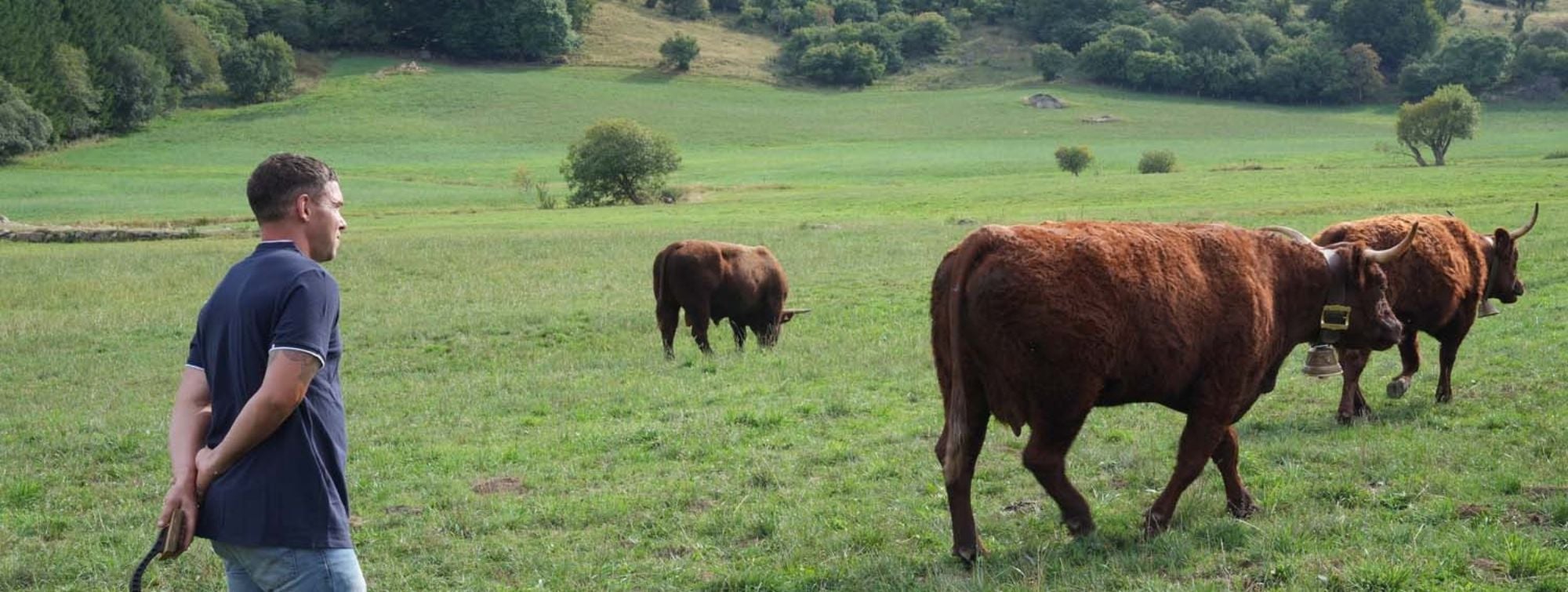
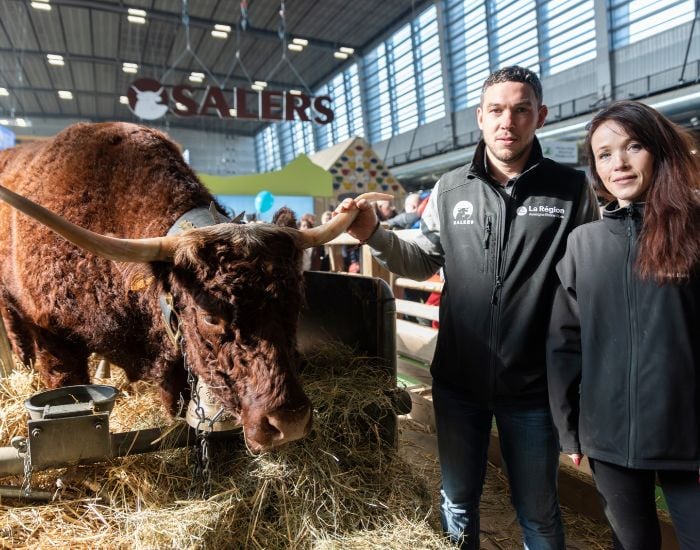
Meet Ovalie, the 2023 Salers ambassador for the International Agricultural Show
Who is Ovalie?
In 2023, Ovalie flew the flag for the Salers breed by becoming the mascot cow for the International Agricultural Show.
Born in January 2018 in the Cézallier region, in Saint-Alyre-ès-Montagne, in the Puy-de-Dôme, she grew up at an altitude of around 1,150 metres, with her breeders, Marine and Michel Van Simmertier.
With her mahogany coat, curly fur and large lyre-shaped horns, Ovalie perfectly embodied the characteristics of her breed.
Calm and gentle, she was also renowned for her maternal qualities. The background of the farmers is also rather unusual: neither Marine nor Michel had any farming background before they started farming.
Having set up their business together in 2018, they have built their farm around a herd of Salers cattle and the optimal utilisation of their animals, through meat production and the sale of breeding stock.
A closer look at the Salers breed
With its mahogany (sometimes black) coat with reddish highlights, curly coat and long lyre-shaped horns , the Salers certainly doesn’t go unnoticed!
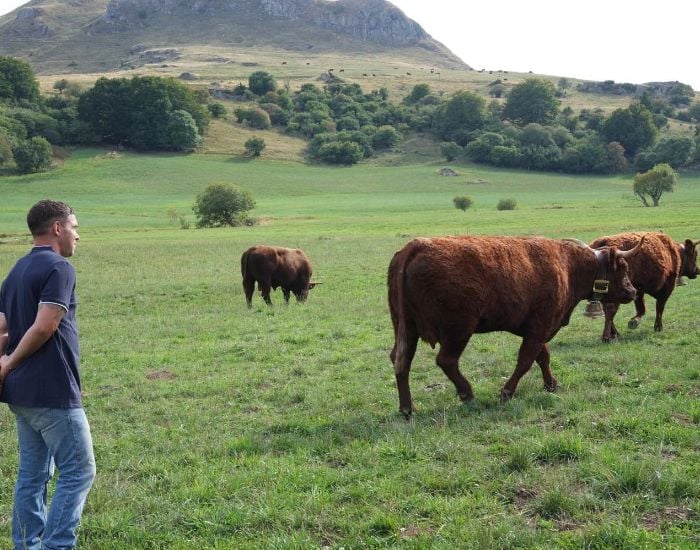
Native to the mountains of Cantal, this hardy breed of cattle is perfectly adapted to the terrain and harsh climatic conditions.
Renowned for its maternal qualities, ease of calving and ability to make the most of grass, it is now mainly reared for its meat.
But the Salers has more than one string to its bow: it also has a long dairy tradition, closely linked to the production of Auvergne’s iconic cheeses.
How can you recognise a Salers cow?
It’s hard to mistake the Salers for any other breed!
Its most striking distinguishing feature is its solid-coloured coat, usually mahogany, sometimes black.
Its coat consists of long, curly hairs, which are particularly noticeable in winter. Another distinctive feature: its slender, light-coloured horns, which flare outwards at the top, forming an elegant lyre-like shape.
Its muzzle is usually pinkish, whilst its mucous membranes are pigmented.
The Salers is a large breed of cow, with a sturdy and well-proportioned build.
Adult females measure approximately 1.40 m at the withers and generally weigh between 650 and 850 kg. Males are larger, with adults weighing up to 900 to 1,100 kg.
Where does the Salers breed come from?
The Salers breed takes its name from the commune of Salers, situated in the Cantal, in the heart of the Massif Central. This mountainous region, characterised by harsh winters and high-altitude summers, has shaped a particularly hardy breed well-suited to grassland farming systems.
In the century, Ernest Tyssandier d’Escous played a major role in improving and selecting the breed. Rather than resorting to cross-breeding with foreign breeds, he favours the selection of the best Salers cattle. His work helps to define the breed’s characteristics and develop its qualities.
Historically, the Salers was a breed with three uses : it provided milk for cheese-making, meat and draught power for agricultural work. In particular, the milk was made into cheese during the summer grazing season, when the herds moved up to the mountain pastures.
Today, the Salers breed is mainly reared for meat production. Nevertheless, it has retained its dairy qualities, which are still valued on some traditional farms.
The Salers breed in figures: 196,000 cows in France (as at January 2025), according to SPIE-BDNI data, processed by the Institut de l’élevage (Idele)
A champion of maternal qualities
The Salers breed is particularly prized by farmers for its maternal qualities. Its fertility, longevity and ease of calving make it a breed well-suited to suckler farming systems.
Thanks to her well-developed pelvis, she has good calving ability. She is also known for her maternal instinct and her ability to produce enough milk to feed her calf. These qualities enable farmers to aim for one weaned calf per cow per year.
A hardy breed of cow, at home in the mountains
The Salers is made for the great outdoors! Its sturdy legs and hardy hooves enable it to move across terrain that is sometimes rugged. It makes effective use of grass and forage, making it particularly well-suited to grassland systems and mountain farming conditions.
A dairy tradition that is still very much alive
Although meat production now dominates, the Salers breed retains a special place in the Auvergne’s cheesemaking heritage. Its milk is notably used in the production of cheeses such as Cantal and Saint-Nectaire. The production of Salers Tradition is covered by a Protected Designation of Origin (PDO) and is governed by specific production specifications, which stipulate, in particular, the use of raw, whole milk from Salers cows. Traditional milking is carried out in the presence of the calf, which is a distinctive feature of this farming system. This dual purpose – for both dairy and beef production – makes the Salers a breed with a particularly rich agricultural history.