The Charolaise: discover France’s great beef breed
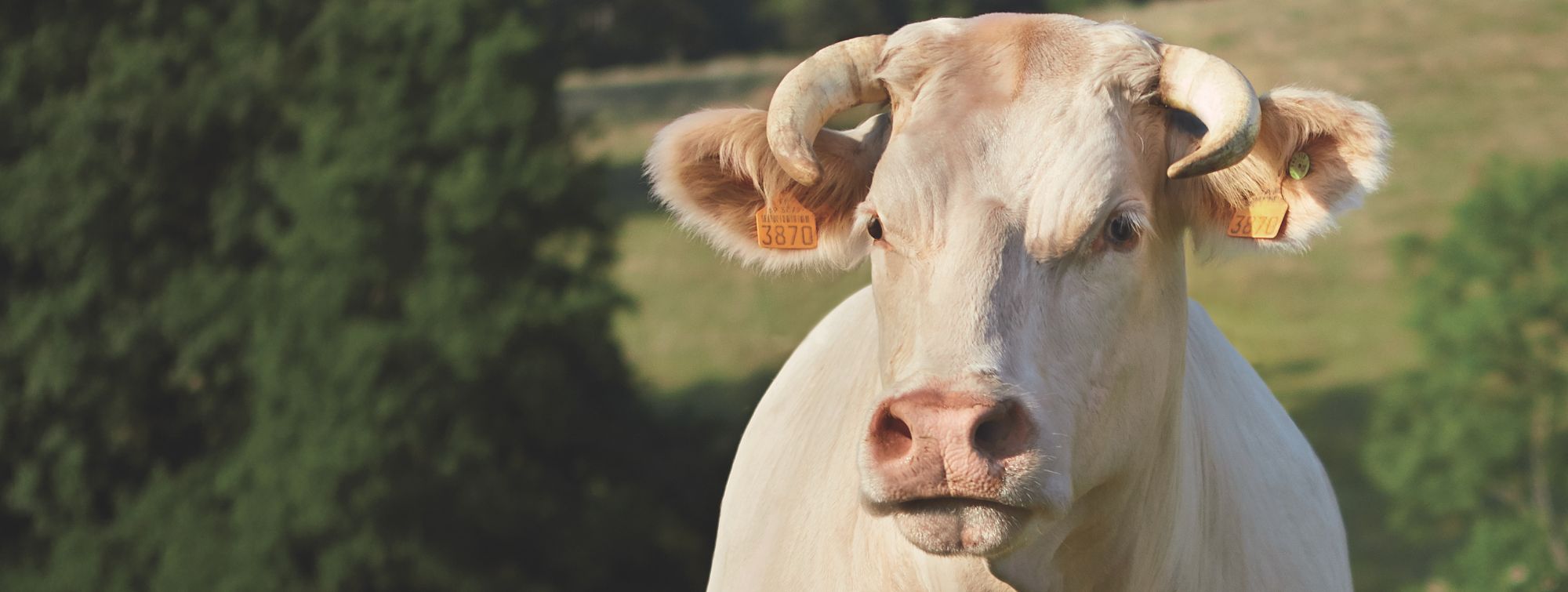
Meet Idéale, the 2020 Charolaise ambassador for the International Agricultural Show
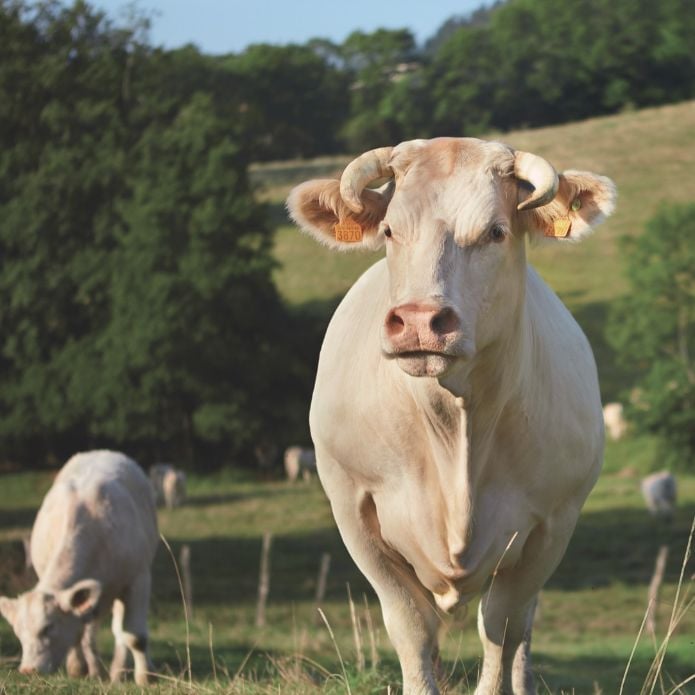
Who is Idéale ?
In 2020, the Charolais breed took centre stage at the International Agricultural Show with Idéale, a six-year-old cow who became the face of this year’s event.
Born and reared at GAEC Goujat in Cours-la-Ville, in the Rhône region, Idéale embodied the characteristics sought after in a Charolais: an imposing build, a broad, muscular back, thick thighs and beautiful crescent-shaped horns.
Her maternal qualities and consistent reproductive performance were also among her strengths.
Her breeder, Jean-Marie Goujat, accompanied Idéale on this media adventure.
Through their story, the work of all the breeders was brought to the fore: the selection of animals, the passing on of expertise and the daily commitment to keeping suckler farming alive.
How can you recognise a Charolais cow?
The Charolais has a uniform coat, ranging from white to cream, with skin and mucous membranes that are generally light in colour, a pale pinkish-white. Its head is relatively short, its forehead broad and its muzzle well-developed.
Its horns, where present, are generally light in colour and may be crescent-shaped.
Some Charolais are born without horns.
This trait, introduced into the breed through selective cross-breeding, is now being developed through genetic selection.
Spotlight on the Charolais
With its white to cream coat, powerful build and well-developed musculature, the Charolais certainly doesn’t go unnoticed!
Originating in Burgundy, this cattle breed has made its mark far beyond its place of origin thanks to its suitability for beef production, its growth potential and its maternal qualities.
As France’s leading suckler breed, it is now reared throughout France and found in over 70 countries around the world.
Where does the Charolais breed come from?
As its name suggests, the Charolais breed originates from the Charolais-Brionnais region, in Saône-et-Loire, in the heart of Burgundy. Its historical heartland extends, in particular, around Charolles and the Arconce valley. For centuries, Charolais cattle have been reared for their draught power, but also for their meat. Their development has gone hand in hand with that of the pastures and livestock farming in their region of origin. Valued for its meat-producing qualities and its suitability for cross-breeding, the breed has expanded internationally and established itself as a benchmark in suckler cattle farming.
The Charolais in figures
- Approximately 1,172,000 cows recorded in France as at 1 January 2025 (source: SPIE-BDNI, processed by Idele)
- 28,743 herds recorded in France in 2022, according to Races de France.
- More than 70 countries are home to Charolais cattle or crossbreeds of this breed.
A champion of meat production
The Charolais is a suckler breed: the cows rear their calves on their own milk until they are weaned. It is primarily selected for its meat-producing qualities, growth rate and conformation.
Its growth potential results in heavy, well-conformed animals.
Its musculature and meat yield are particularly valued by breeders and industry professionals.
But the Charolais is not defined solely by its meat-producing qualities. Breeders also attach great importance on its maternal qualities, its milk production for calves and its longevity. Selection also focuses on ease of calving, to ensure smoother calving experiences.
The Charolais: meat recognised by quality labels
Charolais meat benefits from several official quality and origin labels. ‘Tendre Charolais’ and ‘Plaisir Charolais’ are two Label Rouge beef brands that highlight the breed’s qualities and rearing practices. In terms of geographical indications, ‘Charolais de Bourgogne’ and ‘Bœuf Charolais du Bourbonnais’ hold Protected Geographical Indication (PGI) status, which guarantees their link to a specific region and its rearing traditions.
Finally, ‘Bœuf de Charolles’ is recognised as a Protected Designation of Origin (PDO).
-
What is the Charolaise cattle breed and where does it come from?The Charolaise is a French cattle breed originating from the Charolais region of Burgundy, mainly in the Saône-et-Loire department. Recognisable by its white to cream-coloured coat and well-developed musculature, it is one of the leading beef cattle breeds raised in France. Valued for its meat-producing qualities and excellent growth performance, the breed is now found in many countries worldwide.
-
How can you recognise a Charolaise cow?The Charolaise cow is distinguished by its uniform coat, generally white or cream-coloured, and its imposing build. It has a long, broad body, particularly well-developed muscles along its back and hindquarters, and a relatively short head. When present, its horns are pale and often curve forwards. An adult female generally weighs between 700 and 900 kg.
-
Is the Charolaise a beef or dairy cattle breed?The Charolaise is a cattle breed specialised in beef production. It is particularly valued for its growth rate, muscular development and high carcass yield. Primarily raised in suckler herds, Charolaise cows produce milk to feed their calves. Breeding programmes focus on meat-producing qualities, maternal abilities and overall farming performance.
-
What are the characteristics of Charolaise beef?Beef from Charolaise cattle is valued for its tenderness, flavour and meat quality. The breed is associated with several quality and origin certification schemes, including Bœuf de Charolles PDO and Charolais de Bourgogne Protected Geographical Indication (PGI). These products highlight traditional farming practices, regional heritage and the expertise of cattle farmers.
-
Who is Idéale, the mascot cow of the 2020 Salon International de l'Agriculture?Idéale is a Charolaise cow selected as the mascot of the 2020 Salon International de l'Agriculture. Six years old at the time, she was born and raised at GAEC Goujat in Cours-la-Ville, in the Rhône department, by farmer Jean-Marie Goujat. Recognisable by her pale coat, impressive musculature and crescent-shaped horns, she represented the qualities of the Charolaise breed and the expertise of French beef cattle farmers.