The Normande Cow: Discover the Three-Coloured Cattle Breed
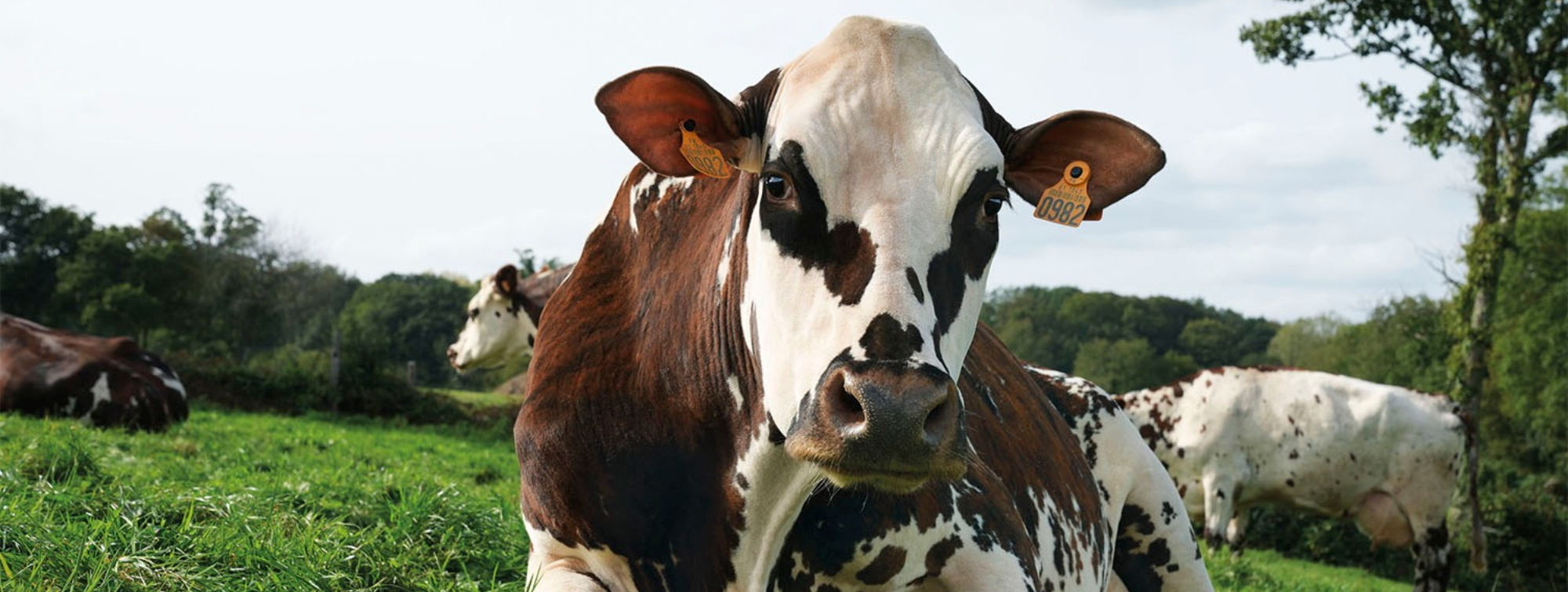
Meet Oreillette, the 2024 Normande ambassador for the International Agricultural Show
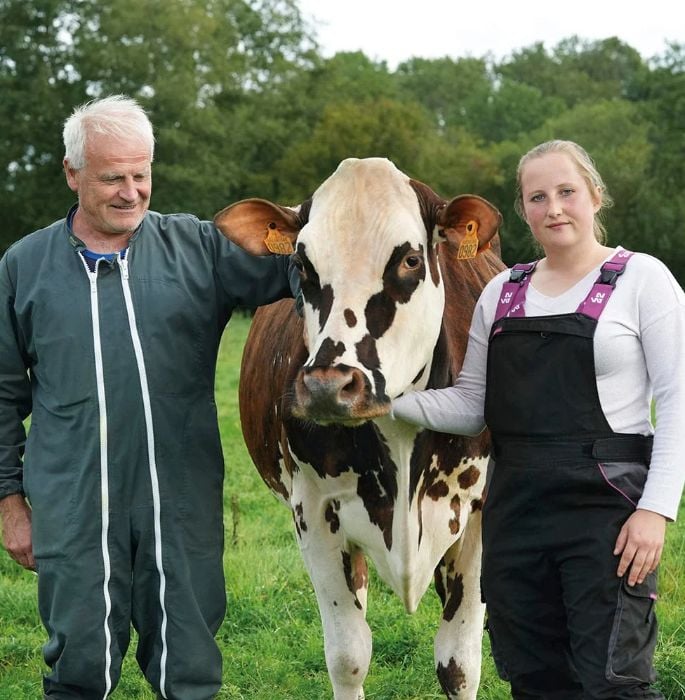
Who is Oreillette ?
With her distinctive three-coloured coat and clearly defined markings around her eyes, Oreillette proudly represented her breed at the 2024 Paris International Agricultural Show.
François, her breeder, took over the family farm in 1987 before passing on his love for the Normandy cattle breed to his daughter Lucie, who joined him in 2020.
Today, father and daughter share the same ambition: to preserve their family farm and its traditions. The milk produced on the farm is delivered to a dairy, where it is made into Camembert de Normandie and Pont-l’Évêque PDO cheeses, both symbols of traditional expertise and quality.
On average, Oreillette's daily milk production is equivalent to 10.5 Camembert cheeses.
She is a worthy descendant of Ramette, her great-grandmother, who remains one of the highest milk-producing cows of the Normandy breed to date.
A closer look at the Normande breed
Recognisable by its distinctive three-coloured coat and the famous “spectacles” that often surround its eyes, the Normandy cow is an iconic breed of the Normandy countryside.
Hardy and well suited to grass-based farming, it stands out for its dual-purpose qualities: it produces rich milk, highly valued for making cheese and dairy products, as well as meat renowned for its flavour and marbling.
How to Recognise a Normandy Cow ?
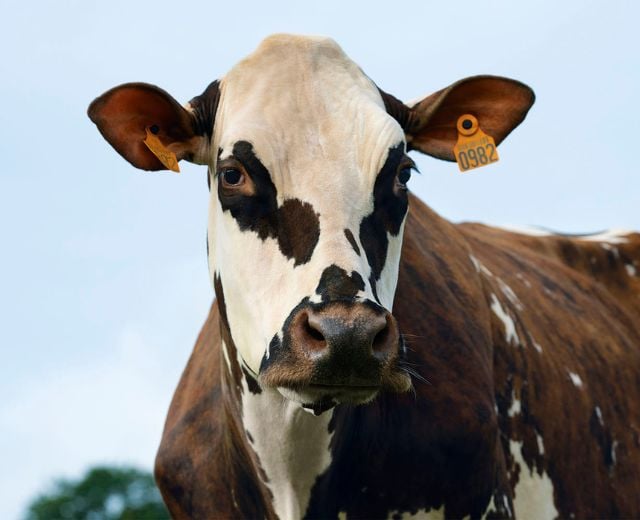
The Normandy cow is distinguished by its three-coloured coat, combining white, fawn and brindle, a darker shade blending brown and black tones.
Depending on how these colours are distributed, the coat may be described as “quail” (predominantly white with coloured patches), “blonde” or “brindle”.
Another distinctive feature is its famous “spectacles”, the coloured markings that typically surround its eyes.
Its head is often white, with pigmented areas also visible around its muzzle. A large-framed breed, the Normandy cow has a long, sturdy body.
Adult females generally weigh between 700 and 800 kg, while males can reach 900 to 1,100 kg.
Where Does the Normandy Cattle Breed Come From?
The Normandy cattle breed originated in Normandy, France. It developed from the combination of several local cattle populations raised during the 18th century: the Cotentine, Augeronne and Cauchoise. In the 19th century, crossbreeding with the English Durham breed helped improve certain characteristics, particularly early maturity and body conformation. Raised in a region where grasslands play a major role in agriculture, the Normandy breed developed a strong ability to make efficient use of grass and forage. Over time, it became established as a dual-purpose breed, producing both high-quality milk and highly valued meat. The Normandy breed has also expanded internationally, particularly in Latin America, where it has been present in several countries for over a century. It is also raised in various European and North African countries.
The Normandy Breed in Figures
233,000 cows in France (2025 figures, source: SPIE-BDNI, Idele)
A Versatile Breed: From Milk to Meat
The Normandy cow is a dual-purpose dairy cattle breed, allowing farmers to benefit from both milk and meat production.
Its milk is particularly rich in fat and protein. It plays a key role in the reputation of several Normandy specialities, including PDO/AOC cheeses such as Camembert de Normandie, Livarot, Pont-l’Évêque and Neufchâtel, as well as Crème d’Isigny and Beurre d’Isigny.
The breed also offers excellent beef qualities, with meat appreciated for its tenderness and marbling.
Its hardiness, ability to make efficient use of forage, fertility and longevity make it particularly well suited to grass-based farming systems.