The Aubrac: discover the cow of the wide open spaces of the Massif Central
Meet Haute, the 2018 Aubrac ambassador for the International Agricultural Show
Who is Haute ?
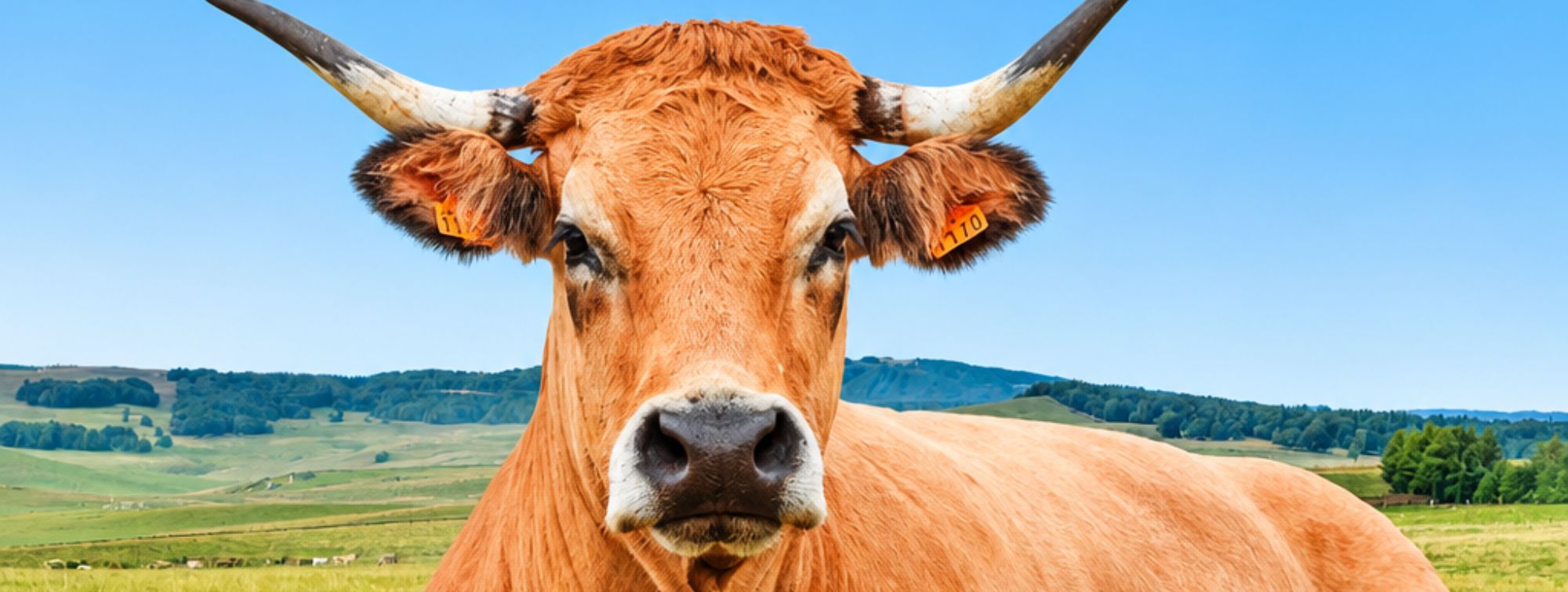
In 2018, the Aubrac breed took centre stage at the International Agricultural Show with Haute, a six-year-old cow reared by Thibaut and Florence Dijols in Curières, near Laguiole, in the Aveyron.
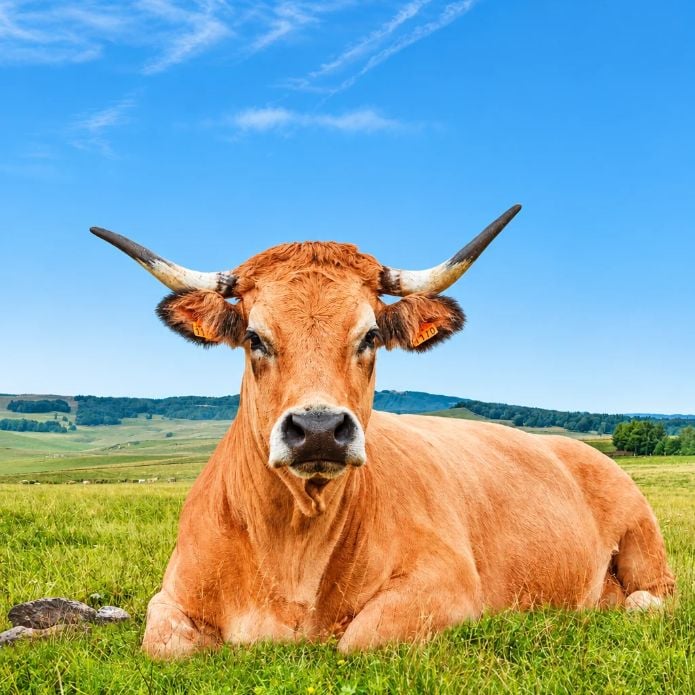
With her wheat-coloured coat, eyes rimmed with black and lyre-shaped horns, Haute perfectly embodied the characteristics of her breed.
Her name referred to her proud head carriage and the way she held her ground amongst the herd.
The daughter of Bijou, a bull that won an award at the Concours Général Agricole in 2010, she was already the mother of four calves at the time of the Show.
She was also accompanied to Paris by her daughter Olympe and by Nature, another of her daughters.
Through Haute, the Show highlighted not only a breed emblematic of the Aubrac highlands, but also the work of the breeders who have contributed to its preservation and development.
How can you recognise an Aubrac cow?
It has a solid-coloured coat, usually wheat-coloured, which can vary in shade.Its eyes are ringed with black, as if lined with kohl, and its mucous membranes, muzzle and hooves are dark.
Medium in size, the Aubrac has a deep chest, sound legs and sturdy limbs.This build enables it to move across rugged terrain and roam the pastures in search of food.
Spotlight on the Aubrac
With its wheat-coloured coat, eyes rimmed with black and lyre-shaped horns, the Aubrac has a truly distinctive appearance!
Native to the volcanic highlands of the southern Massif Central, this cattle breed is renowned for its hardiness, its maternal qualities and its ability to adapt to demanding farming conditions.
Long used for draught work, milk and meat, it is now mainly reared for its beef-producing qualities.
A breed that has successfully reinvented itself without losing the qualities that define its identity.
Where does the Aubrac breed come from?
As its name suggests, it originates from the Aubrac plateau, in the south of the Massif Central.
Its historical heartland spans three departments: Aveyron, Cantal and Lozère. The Aubrac in figures Nearly 285,000 cows were recorded in France in 2026 (cows over 3 years old), according to the Aubrac Breed Selection Organisation.
A champion of hardiness and maternal qualities
Today, the Aubrac is primarily a suckler breed, used for meat production.
The cows rear their calves on their own milk and are particularly prized for their maternal qualities.
The breed is distinguished by its fertility, ease of calving and maternal instinct. The cows are renowned for their self-sufficiency and their ability to rear their calves in sometimes difficult conditions.
Their hardiness and sturdy build enable them to roam the pastures and make the most of a variety of forage resources.
Meat recognised under quality labels
Meat from the Aubrac breed bears two official quality and origin labels.
- ‘Bœuf Fermier Aubrac Label Rouge’ refers to purebred Aubrac cattle aged between 30 months and 10 years. They are reared on a single farm, where they feed on mountain pasture grass during the summer and hay produced on the farm during the winter. The sector was awarded its Label Rouge in 1999.
- Fleur d’Aubrac PGI is meat from heifers aged between 24 and 42 months, born to an Aubrac dam and a Charolais sire. This crossbreed combines the maternal qualities of the Aubrac with the Charolais’ suitability for meat production. The animals are born, reared, fattened and slaughtered within the geographical area covered by the PGI, which was granted in 2010.